

ACERT vs SCR: Two Philosophies for Cutting Diesel Emissions
Cat bet on ACERT (attack NOx inside the cylinder). Cummins, Volvo, and Detroit bet on SCR (treat it afterward). A technical comparison.
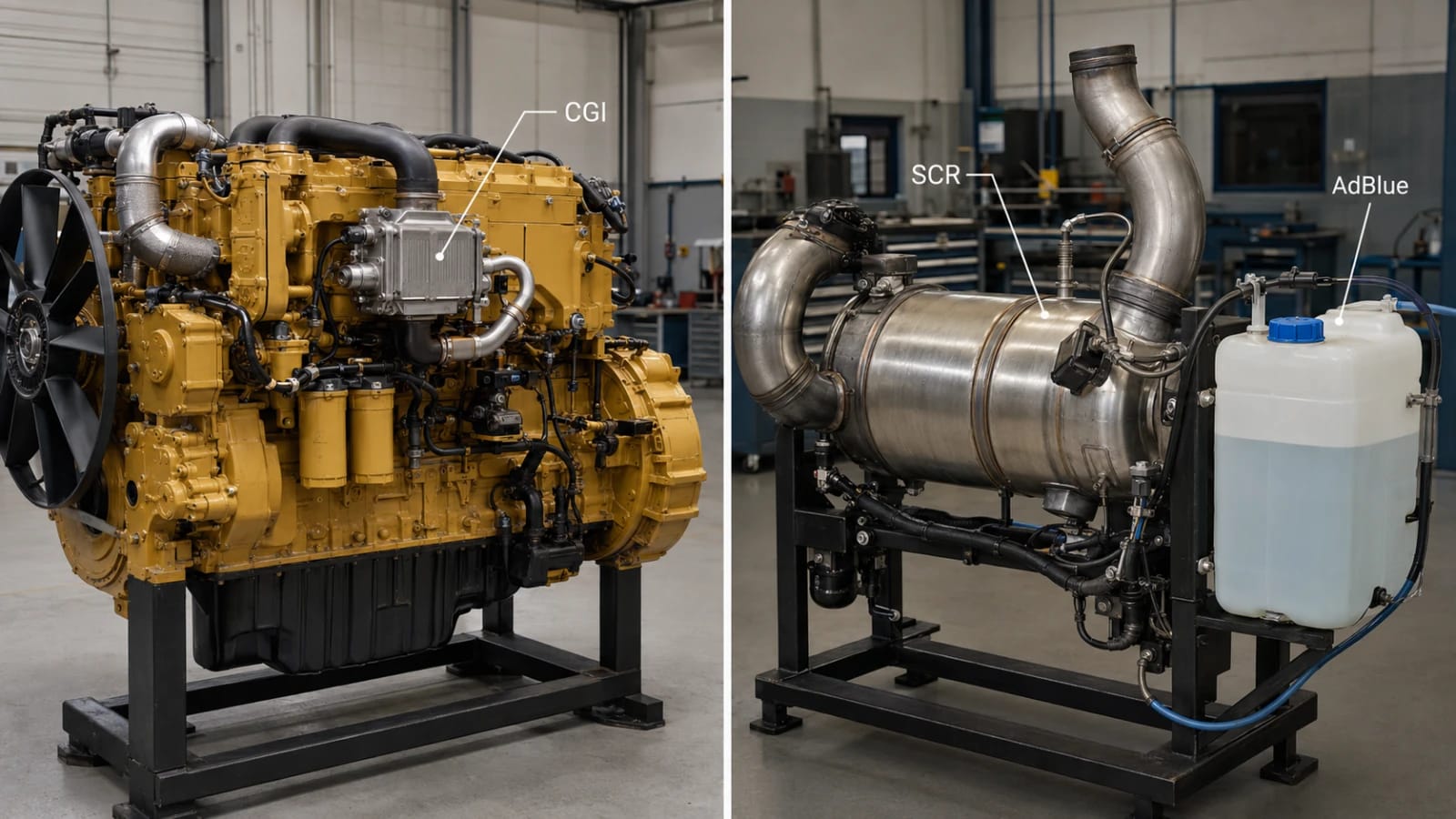
When the EPA announced in the 1990s that it was going to tighten diesel emissions limits, the heavy-duty engine industry split into two camps:
- Cat, with ACERT: reduce NOx inside the cylinder, preventing it from forming in the first place.
- Cummins, Volvo, Detroit, Mack: reduce NOx after combustion, using SCR (Selective Catalytic Reduction).
These were two fundamentally different philosophies, each with its own technical, economic, and logistical advantages. This article compares both and explains why the industry eventually converged on one.
The ACERT philosophy: prevent NOx from forming
The ACERT system we’ve already covered in detail in this series attacks NOx at the source. The logic:
“If NOx forms because of high combustion temperatures, lower the combustion temperature.”
ACERT’s tools for cutting peak temperature:
- CGI (Cooled Gas Induction) — recirculates cooled exhaust gas back into the intake, lowering combustion temperature.
- High injection pressure — finer atomization, more uniform and controllable combustion.
- Multiple injection events — better distribution of released heat.
- Precise timing — avoids unnecessary temperature spikes.
- Air-to-air aftercooling (ATAAC) — denser, cooler intake air.
Result: NOx is reduced at the source, with no need to treat the exhaust gases afterward.
Advantages of ACERT:
- No additional fluid required (no AdBlue).
- No tank, lines, or urea injection nozzle needed.
- Less added weight on the machine.
- No refill logistics.
- Compatible with standard diesel fuel.
Disadvantages of ACERT:
- Lower thermal efficiency — lowering combustion temperature means giving up some performance per liter of fuel.
- The CGI cooler and valve are critical, expensive components that can fail.
- Higher PM output — cooler combustion produces more soot, which demands a more robust DPF.
- Limited ceiling on NOx reduction — there’s a physical floor ACERT alone can’t get past. Once Tier 4 Final (2014) took effect, ACERT alone was no longer enough.
The SCR philosophy: treat NOx afterward
SCR is an aftertreatment technology that chemically converts NOx into harmless nitrogen.
How SCR works
- The engine can run hotter, more efficient combustion (without the constraints of CGI or conservative timing). This produces more NOx but also better efficiency.
- The exhaust gases pass through the aftertreatment system:
- DOC (Diesel Oxidation Catalyst) — oxidizes HC and CO.
- DPF (Diesel Particulate Filter) — traps PM.
- Urea injection nozzle (AdBlue/DEF) — doses the fluid based on the amount of NOx present.
- SCR catalyst — a chamber with a titanium-vanadium or zeolite catalyst. The urea decomposes into ammonia (NH₃), and the NH₃ reacts with NOx according to:
4 NH₃ + 4 NO + O₂ → 4 N₂ + 6 H₂OIn other words: NOx + ammonia → harmless nitrogen + water.
- ASC (Ammonia Slip Catalyst) at the end — captures any leftover ammonia that didn’t react.
Advantages of SCR
- Higher engine efficiency — the engine can run at its thermal sweet spot, gaining 3-5% efficiency compared to an EGR/CGI engine.
- Much greater NOx reduction — up to 90% removal, well beyond what ACERT alone can achieve.
- Mechanically simpler engine — no CGI valve, cooler, or flow sensor.
- Lower maintenance on the engine itself — CGI is a common source of failures.
Disadvantages of SCR
- Requires an additional fluid (AdBlue/DEF) — a new tank, refill logistics, and the risk of contamination from fuel or water.
- AdBlue freezes at -11 °C (12 °F) — requires heating in cold climates.
- Urea-resistant stainless-steel components — more expensive.
- Engine derates if AdBlue runs out — a usage restriction.
- Higher total system cost — DOC + DPF + SCR + ASC adds up.
- AdBlue logistics in remote areas — not always available.
Why the industry converged on SCR + DPF
Until about 2010-2011, both philosophies were viable. Cat sold ACERT and everyone else sold SCR. Customers chose based on their application and logistics.
But once the EPA announced Tier 4 Final standards (2014 in the US, Stage IV in Europe in 2014, Stage V in 2019), NOx limits became so strict that ACERT alone could no longer keep up:
- Tier 4 Final: 0.4 g/kWh of NOx.
- Pure ACERT with CGI topped out around ~1.5-2.0 g/kWh.
- SCR could easily hit 0.4 g/kWh or lower.
Cat had to accept reality and add SCR to its larger engines as well. Modern Cat engines in the C13, C15, and larger range — in on-highway applications and some industrial ones — use ACERT + SCR combined: combustion control AND chemical aftertreatment working together.
In smaller off-highway applications, Cat stuck with ACERT + DPF longer, but eventually migrated to SCR there too.
Comparison summary
| Aspect | ACERT | SCR |
|---|---|---|
| Where it acts | Inside the cylinder | In the exhaust (after combustion) |
| Method | Lower combustion temperature | Chemical treatment with NH₃ |
| Additional fluid | None | AdBlue/DEF |
| Thermal efficiency | Lower (~3-5% less) | Higher (engine runs at optimum) |
| Maximum NOx reduction | ~50-60% | ~90% |
| PM (soot) | More (needs a more robust DPF) | Less (cleaner combustion) |
| Key components | CGI valve, cooler, flow sensor | AdBlue tank, pump, nozzle, catalyst |
| Operational risk | CGI failure in service | Running out of AdBlue → derate |
| Initial cost | Lower | Higher |
| Maintenance cost | Expensive CGI cooler, frequent DPF | Ongoing AdBlue, catalysts |
| Tier 4 Final compliance | Not sufficient alone | Sufficient |
Which one to choose today
If you’re buying new equipment, the decision has already been made by the manufacturer — nearly all modern engines use some combination of SCR + DPF + DOC, with or without supplemental EGR. Cat, Cummins, Volvo, Detroit, John Deere: all are aligned on this architecture now.
If you’re buying used equipment, it’s important to understand which technology it carries:
- Purely mechanical engine (pre-2007): no ACERT, no SCR, no DPF. Simple, rugged, but polluting. Growing legal restrictions in some markets.
- Pure ACERT engine (2007-2013): CGI and DPF, no SCR. Reliable but demanding on CGI maintenance.
- ACERT + SCR engine (2014+): more complex, more expensive to maintain, but meets modern standards.
- SCR + DPF only engine (Cat’s competitors): reliable, requires discipline with AdBlue.
For work in remote areas without AdBlue infrastructure, a pure ACERT engine may be preferable. For operation in areas with strict emissions regulations, an SCR-equipped engine is the way to go.
Cat’s hybrid approach and the post-ACERT evolution
Cat didn’t fully abandon the ACERT philosophy. Its modern engines combine:
- Optimized combustion (an ACERT legacy).
- Simplified CGI (less critical than in pure ACERT designs).
- SCR for the heavy lifting of NOx reduction.
- DPF for PM.
It’s a hybrid approach: use the best technology on each front. More expensive, yes, but it meets modern standards with room to spare.
The long-term outlook
The ACERT vs SCR debate is, in a sense, a discussion from the past. The entire diesel industry is under regulatory pressure to decarbonize. The next 10-20 years will bring:
- Even cleaner diesel engines (post-Tier 4 Final, with Euro 7 and equivalent standards).
- Renewable diesel / HVO as an alternative to fossil diesel.
- Diesel-electric hybrid engines in heavy equipment.
- Fully electric engines in light- and medium-duty applications.
- Hydrogen engines in testing for heavy-duty use.
Cat, Cummins, Volvo — all are investing in these technologies. The “pure” ACERT or SCR diesel engine is slowly heading toward becoming history. But in the meantime, understanding them remains essential for operating and maintaining the millions of machines already in the field.
Bottom line
ACERT bet on preventing NOx formation inside the cylinder through CGI, high injection pressure, and electronic control. It was Cat’s play between 2007 and 2013.
SCR bet on treating NOx after combustion with urea and catalysts. It was the play of nearly all the competition.
SCR won the race — not because ACERT was “bad,” but because emissions standards became so strict that only SCR could meet them efficiently. Cat itself had to adopt it in its larger modern engines.
Today’s modern heavy-duty diesel engines use a combination of combustion control + DPF + SCR + DOC — the best of both philosophies. And the next challenge is no longer NOx: it’s CO₂ and decarbonization.
This series on ACERT is, in a sense, the story of a transitional technology — well engineered, useful in its time, but overtaken by regulatory reality. Understanding it is key to understanding why modern diesel engines are built the way they are.
Frequently Asked Questions
What is SCR and how does it differ from ACERT? +
What is AdBlue or DEF? +
Why did Caterpillar bet on ACERT first instead of SCR? +
Does an SCR engine also need a DPF? +
What happens if I run out of AdBlue on an SCR engine? +
Sources
This article was drafted with AI assistance and reviewed by our editorial team before publishing.