

How a DPF Works Inside: Substrate, Catalyst, and Washcoat
Ceramic substrate, platinum/palladium catalyst, and washcoat: how the DPF's internal layers work together to trap and oxidize soot.
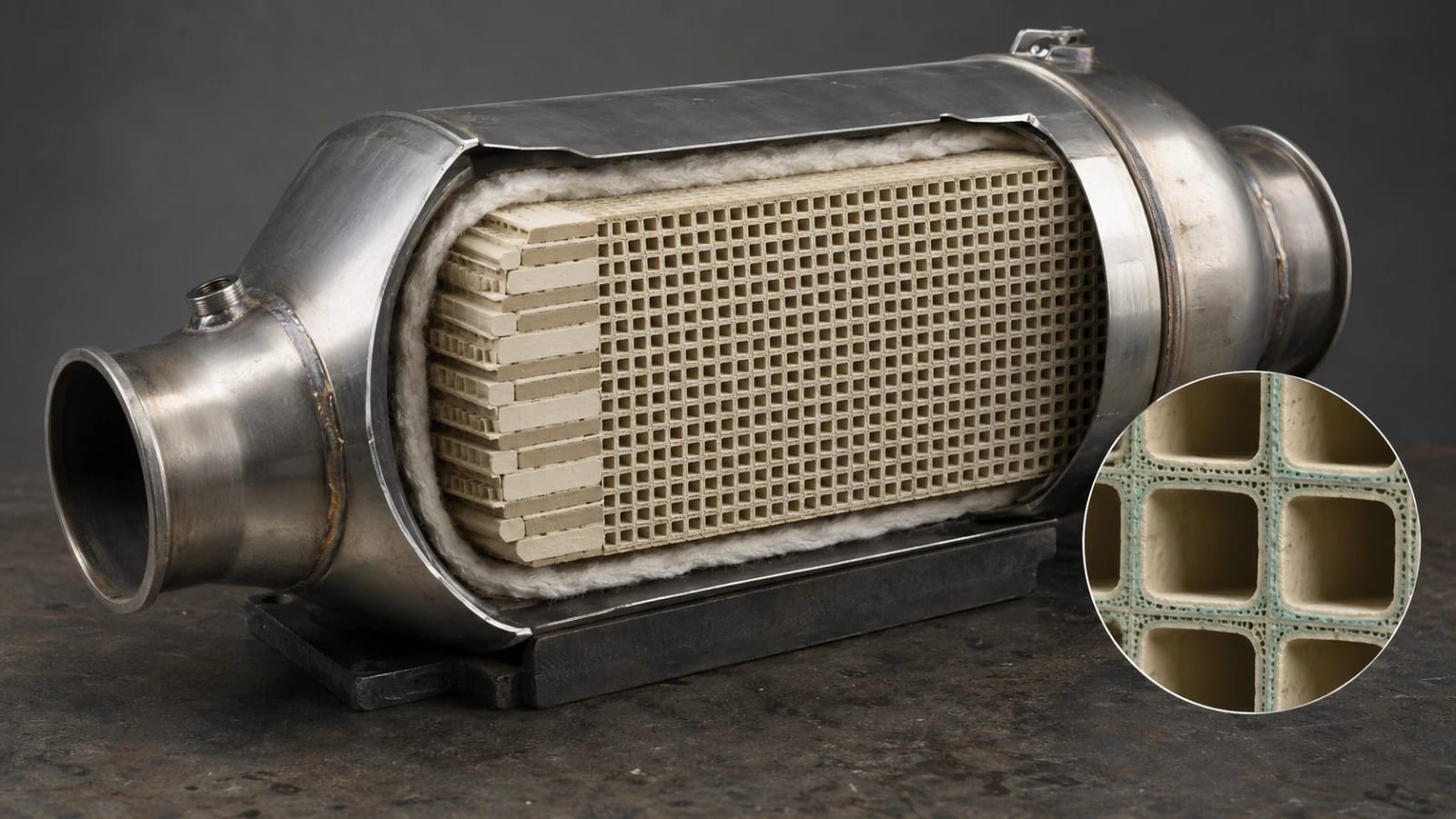
A DPF isn’t a magic box that just traps soot. It’s a precision engineering component built from advanced materials: a ceramic matrix with thousands of channels, coated with a porous microstructured layer called washcoat, on top of which a precious metal catalyst is deposited — typically platinum, sometimes combined with palladium or rhodium.
Each layer has a specific job. Understanding how they work together is the foundation for knowing why a DPF can fail, why some last longer than others, and why poor-quality diesel or the wrong oil can destroy one in a matter of hours.
DPF anatomy: 3 stacked layers
Cut a DPF in half and look at it under a microscope, and you’ll see three things:
- The substrate: the ceramic matrix with thousands of honeycomb-style channels.
- The washcoat: a porous layer coating the substrate walls.
- The catalyst: microscopic particles of precious metal deposited on the washcoat.
Let’s go through each layer.
Layer 1: the ceramic substrate
The substrate is the DPF’s physical structure. It determines how much soot the filter can hold, how much gas flow it can handle, and how much temperature it can withstand.
Wall-flow structure
The substrate’s geometry is called wall-flow. The channels are alternately plugged:
- One channel is plugged on the inlet side.
- The neighboring channel is plugged on the outlet side.
- The next one is plugged on the inlet side again. And so on.
This alternating pattern forces the exhaust gases to pass through the porous walls between channels to get from the inlet side to the outlet side. And it’s on those walls that soot gets trapped.
A typical substrate has 200-300 channels per square inch (CPSI) and wall thickness of 300-400 microns.
The two dominant materials
The substrate is manufactured primarily from two ceramic materials:
Cordierite
A magnesium-aluminum silicate mineral (Mg₂Al₄Si₅O₁₈), produced by sintering clays and talc at high temperature.
Advantages:
- Lower cost (relatively speaking — it’s still advanced ceramic).
- Low coefficient of thermal expansion — doesn’t crack under small temperature swings.
- Low density — lighter substrates, lighter complete DPF units.
Disadvantages:
- Relatively low melting point (~1,450 °C / 2,642 °F).
- Limited sustained thermal tolerance — can’t handle more than 900-1,000 °C (1,652-1,832 °F) for extended periods.
- Less resistant to severe thermal shock — an uncontrolled regeneration event that hits 1,100 °C (2,012 °F) can crack it.
Typical application: on-highway trucks, medium-duty heavy equipment, buses, stationary generators.
Silicon carbide (SiC)
A compound of silicon and carbon (SiC), produced by industrial sintering at temperatures above 2,000 °C (3,632 °F).
Advantages:
- Very high melting point (2,700 °C / 4,892 °F).
- Sustained thermal tolerance up to 1,400 °C (2,552 °F) — withstands aggressive regenerations and severe thermal cycling.
- Excellent thermal conductivity — heat distributes evenly, avoiding hot spots that could crack the material.
- High mechanical strength — handles vibration and shock well.
Disadvantages:
- High cost — can triple the price of a cordierite substrate.
- Higher density and weight — heavier DPF units.
- Greater thermal rigidity — requires segmentation (several blocks assembled together) to accommodate expansion, adding manufacturing complexity.
Typical application: mining (where duty cycles are extreme), heavy-duty equipment, marine and rail applications.
Across the Cat ACERT lineup, most standard applications use cordierite; the most demanding ones (793 mining trucks, 6015+ excavators) use silicon carbide.
Layer 2: the washcoat
A very thin, highly porous layer called washcoat is applied over the substrate walls. It’s a slurry of ceramic oxides (typically alumina Al₂O₃, sometimes mixed with silicates and stabilizers) applied as a liquid suspension and then calcined.
Main function: effective surface area
The washcoat doesn’t filter soot and doesn’t catalyze reactions on its own. Its function is purely structural: increase the surface area available for the catalyst to be deposited on.
Without a washcoat, the catalyst would only contact the flat surface of the substrate walls — very little area. With a washcoat, a porous microstructure is created with an effective surface area hundreds to thousands of times larger. This lets very little precious metal catalyze the needed reactions.
Technical requirements
A good washcoat needs to:
- Adhere firmly to the substrate even under extreme thermal cycling.
- Maintain its porosity after thousands of hours at high temperature.
- Remain chemically stable against exhaust gases (sulfates, soot, water, acids).
- Not excessively restrict gas flow.
When the washcoat degrades (thermal aging, sulfur contamination, or metal contamination from engine oil), it loses effective surface area and the catalyst becomes “encapsulated” — the DPF stops working well even though the substrate itself is intact. This is a common cause of premature replacement.
Layer 3: the platinum catalyst
Microscopic particles of precious metal are deposited on the washcoat — typically:
- Platinum (Pt): the main player. Catalyzes the oxidation of HC and CO, and the formation of NO₂ that drives passive regeneration.
- Palladium (Pd): sometimes combined with platinum to improve low-temperature activity and reduce cost.
- Rhodium (Rh): less common in DPFs (more commonly used in three-way catalysts on gasoline engines), but it does appear in some designs.
Quantity and cost
A typical DPF contains between 2 and 5 grams of platinum distributed across the entire internal surface. That may sound like little, but:
- Platinum price in 2025: USD 30-35 per gram.
- Precious metal content per DPF: USD 60-175.
That’s a significant fraction of the component’s total cost. It’s why used DPFs have resale value as scrap for precious metal recovery.
What reactions it catalyzes
The platinum catalyst in the DPF performs three functions simultaneously:
- HC oxidation: unburned hydrocarbons + O₂ → CO₂ + H₂O
- CO oxidation: 2CO + O₂ → 2CO₂
- NO₂ formation: 2NO + O₂ → 2NO₂
The third is critical: NO₂ is a much more aggressive oxidizer than O₂, and it helps burn off accumulated soot at much lower temperatures (200-350 °C / 392-662 °F) than oxidation with pure oxygen alone (which requires 550+ °C / 1,022+ °F).
This is the mechanism behind the DPF’s passive regeneration — the filter cleans itself while the engine runs under normal operating conditions, with no intervention needed.
What destroys these 3 layers
Each layer has its own enemy:
Enemies of the substrate
- Uncontrolled regenerations that exceed 1,100 °C / 2,012 °F (cordierite) or 1,400 °C / 2,552 °F (SiC) → internal cracking.
- Thermal shock from excessive soot buildup followed by a forced regeneration.
- Extreme vibration without proper elastic mounting.
Enemies of the washcoat
- Thermal aging at sustained high temperature → loss of porosity.
- Sulfate contamination from fuel with high sulfur content.
- Engine oil metals (Ca, Zn, P) that deposit and “poison” the surface.
Enemies of the catalyst
- Sulfur in the fuel → sulfur bonds with the platinum and blocks catalytic activity. That’s why ULSD (Ultra Low Sulfur Diesel, <15 ppm) is used.
- Heavy metals from engine oil — same mechanism. That’s why low-SAPS CJ-4 or CK-4 oil (Sulfated Ash, Phosphorus, Sulfur) is required.
- Poisoning from poorly formulated alternative fuels (uncertified B100 biodiesel, poorly combusted LPG in dual-fuel applications).
Bottom line
The DPF combines three layers of technology: a ceramic substrate that structures the filter and withstands heat, a washcoat that multiplies the effective surface area, and a precious metal catalyst that speeds up the chemical reactions inside the filter.
Each layer is sensitive to specific factors — extreme temperature, sulfur, oil-derived metals — and keeping all three in good shape depends on the fuel and oil you use. Running ULSD diesel and CJ-4/CK-4 oil isn’t a marketing recommendation — it’s a technical requirement for all three layers to work as designed.
In upcoming articles, we’ll cover how regeneration works — the process that burns off accumulated soot — and how maintenance and ash cleaning are done once the DPF can no longer self-clean.
Frequently Asked Questions
What is the substrate of a DPF? +
What is the washcoat in a DPF? +
Why does the DPF use platinum as a catalyst? +
Which is better: cordierite or silicon carbide (SiC)? +
How much platinum is in a typical DPF? +
Sources
This article was drafted with AI assistance and reviewed by our editorial team before publishing.