

Volvo D7E Engine: What It Is, Applications, and Features
The Volvo D7E is a 6-cylinder, 7-liter engine with common rail and Euro 4 SCR, used in medium trucks and buses. We cover all its features.
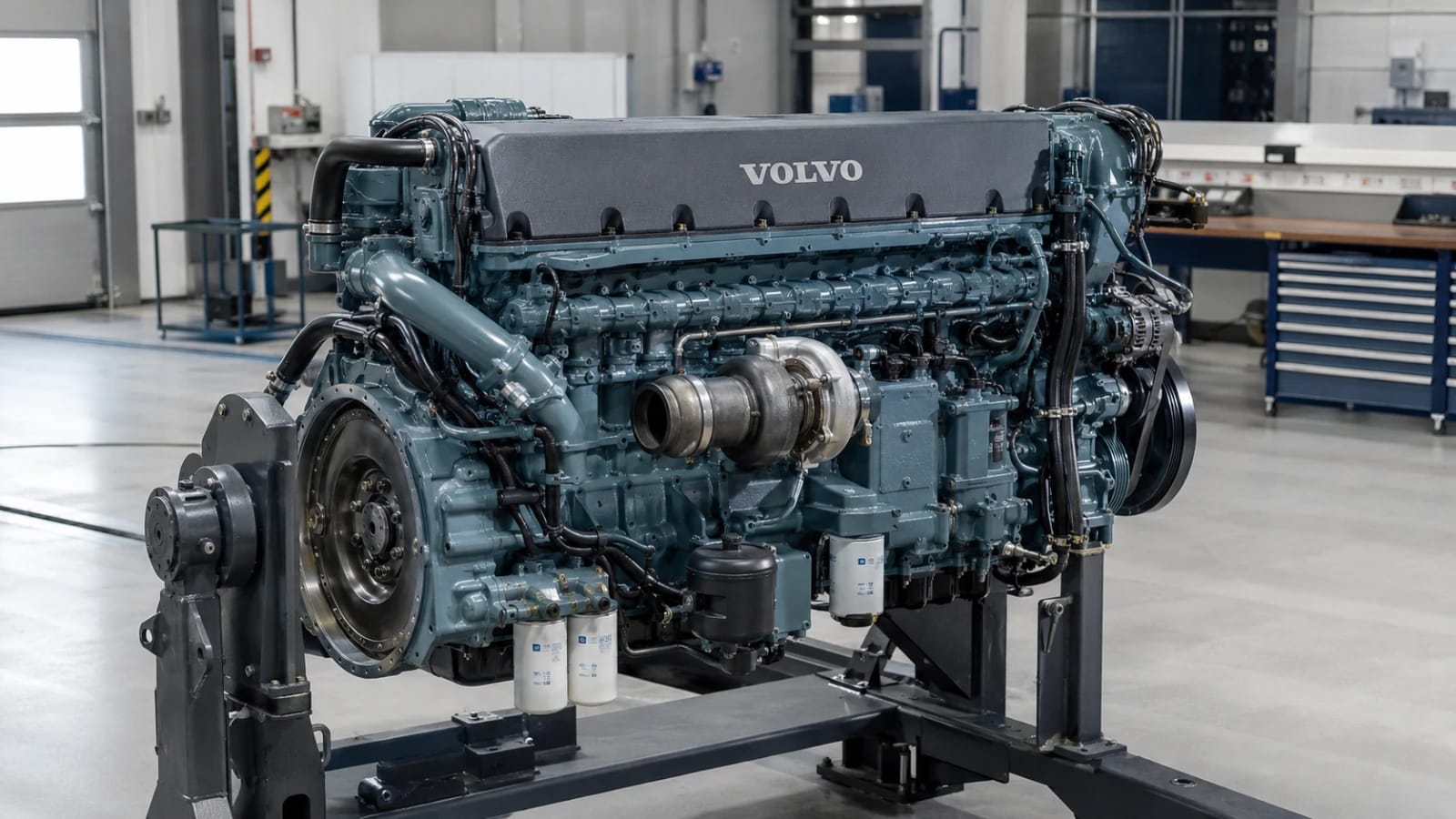
The Volvo D7E is one of the most versatile diesel engines in Volvo Trucks’ mid-range lineup. It covers the middle segment of trucking — 12-19 ton trucks and urban/intercity buses. This article covers what it is, which vehicles use it, and its technical features per the Volvo Trucks manual.
Engine overview
From the official Volvo manual:
The D7E engine, which uses SCR (exhaust gas treatment), meets Euro 4 emissions regulations and was introduced to the market in 2006. The engine displaces 7 liters and features a completely new common rail system. The D7E 290 is a six-cylinder in-line diesel engine with direct injection, a turbocharger, intake air cooling, and electronic injection management (EMS).
In one sentence: in-line 6-cylinder diesel, 7 liters, common rail, SCR, with electronic management.
Main technical features
- Displacement: 7 liters.
- Configuration: 6 cylinders in-line.
- Injection: direct common rail.
- Forced induction: turbocharger with intercooler.
- Management: EMS (Electronic Management System).
- Aftertreatment: SCR with DEF (Euro 4/5).
- Applications: medium trucks (Volvo FL/FE), buses (Volvo B7R, B7RLE), industrial configurations.
Versions and calibrations
Volvo produces the D7E in several calibrations depending on market demand:
| Version | Power | Peak torque | Typical application |
|---|---|---|---|
| D7E 240 | 240 HP | ~1,050 Nm | Urban bus, distribution |
| D7E 260 | 260 HP | ~1,200 Nm | Medium truck, intercity bus |
| D7E 290 | 290 HP | ~1,300 Nm | Medium-heavy truck |
| D7E 320 | 320 HP | ~1,400 Nm | Light-heavy truck |
The exact calibration is identified on the engine data plate.
Concrete applications
In Volvo trucks
Volvo FL:
- Medium truck for urban and intercity distribution.
- Gross weight 12-18 tons.
- Typical 4x2 or 6x2 configuration.
Volvo FE:
- Truck for specialized urban applications (garbage, mixer, etc.).
- Low cabin for maneuvering in the city.
- Similar weight range to the FL.
Volvo FM (some variants):
- Large-capacity truck — the D7E version is the lightest in the segment.
- 6x2 or 6x4 configurations.
In Volvo buses
Volvo B7R:
- High-capacity intercity bus.
- Longitudinal rear engine.
- Widely used in long-haul South American fleets.
Volvo B7RLE:
- Low-floor urban bus.
- Very common in Latin American BRT (Bus Rapid Transit) systems.
Volvo B270F:
- Articulated low-floor urban bus.
- The heavier version in the segment.
Volvo’s SCR strategy
A unique aspect of the D7E is Volvo’s early bet on SCR.
While most manufacturers (Cummins, Cat, Detroit) were using EGR + DPF to meet Euro 4 / EPA 2007, Volvo chose direct SCR with less EGR.
Advantages of the SCR bet:
- Lower fuel consumption (2-4% less than heavy EGR).
- Less thermal stress on the engine.
- A smaller (or no) DPF.
Disadvantage:
- Requires a DEF/AdBlue system with a tank, pump, and doser.
- The operator has to refill DEF.
In the long run, Volvo’s strategy won out — most manufacturers eventually migrated to SCR too. The D7E was a pioneer in its segment.
D7E vs. other engines
D7E vs. Cummins ISX
They don’t compete directly, since they’re in different segments:
| Aspect | D7E | ISX |
|---|---|---|
| Displacement | 7 L | 15 L |
| Power | 240-320 HP | 400-600 HP |
| Application | Medium (12-19 t) | Heavy (30-45 t) |
| Main market | Europe/Latam | USA/Latam |
| Typical consumption | 25-35 L/100 km | 40-55 L/100 km |
D7E vs. Mercedes OM 926
They compete in the same segment:
- Both are 6-cylinder, 7-liter engines.
- Both use common rail.
- Differences: Mercedes has a better service network in Central Europe; Volvo has better coverage in Latam and Northern Europe.
Displacement and mechanical architecture
Total displacement: 7 liters = 7,000 cm³.
Per cylinder: 7,000 / 6 = 1,166 cm³.
Approximate bore and stroke: 108 mm × 130 mm (typical D7).
Firing order: 1-5-3-6-2-4 (common for in-line sixes).
Compression ratio: ~17:1 (typical for common rail engines).
Dry weight: ~700 kg.
Common rail fuel system
From the manual: “completely new.” When it launched in 2006, it was Volvo’s most modern common rail generation.
Operating pressure: typically 1,600-1,800 bar.
Configuration:
- Feed pump (low pressure).
- Pre-filter with water separator.
- Fine secondary filter.
- High-pressure pump.
- Common rail with a pressure sensor.
- 6 electronic injectors.
We cover the complete system in detail in the article on the D7E fuel system.
EMS electronic management
The D7E uses EMS (Electronic Management System) — Volvo Trucks’ electronic management system.
Function: commands all engine actuators in real time based on sensor signals.
Similar to: Cummins CENTRY, Cat ECM, Detroit DDEC.
Diagnostic tool: Volvo Tech Tool (VDA / Impact) — Volvo’s equivalent of Cummins INSITE. Official software plus a USB interface.
Specific applications across the Americas
In South America, the D7E is especially present in:
Brazil:
- Urban buses in large fleets (São Paulo, Rio, Curitiba).
- Medium distribution trucks for beverages and food.
- Very common in medium-distance logistics fleets.
Argentina:
- Intercity buses for companies like Chevallier and Andesmar.
- Urban distribution trucks in Buenos Aires.
Colombia:
- Bogotá’s TransMilenio BRT system (B7R and B7RLE versions).
- Large fleet trucks.
Chile:
- Santiago’s RED (Metropolitano) system with the B7RLE.
- Service trucks.
Service and maintenance
Recommended oil: VDS-3, VDS-4, or VDS-4.5 (Volvo specification).
Typical intervals:
- Oil change: 30,000-50,000 km on-highway.
- Filter change: same interval as oil.
- Coolant change: every 240,000 km or 3 years.
- Valve adjustment: every 200,000 km.
Service with Volvo Tech Tool: every 100,000 km is ideal — it catches problems early and updates calibrations.
In summary
The Volvo D7E is the 7-liter, 6-cylinder engine that covers the medium segment of European and Latin American trucking. Introduced in 2006 with pioneering SCR, it meets Euro 4/5 standards with good consumption and reliability.
Its 240-320 HP are ideal for 12-19 ton trucks and intercity buses. It’s found in most modern Latin American fleets.
With correct maintenance (VDS-3+ oil, filters kept current, SCR system running well) it can reach 1,000,000-1,500,000 km of service life. It’s a well-understood engine with a broad Volvo service network — a solid “workhorse” of medium-duty transport.
In upcoming articles we’ll open up each D7E system in detail: mechanical structure, common rail, injectors, lubrication, cooling, turbo, and electronic control.
Frequently Asked Questions
How much power does the Volvo D7E engine have? +
What vehicles use the Volvo D7E? +
Does the D7E meet modern emissions standards? +
How does the D7E differ from other Volvo engines? +
How long does a Volvo D7E engine last? +
Sources
This article was drafted with AI assistance and reviewed by our editorial team before publishing.