

Cummins Signature, ISX, and QSX15 Engines: The Complete Guide
The Cummins Signature, ISX, and QSX15 are the most widely used 15-liter engine family in heavy trucks and equipment. We cover features, differences, and applications.
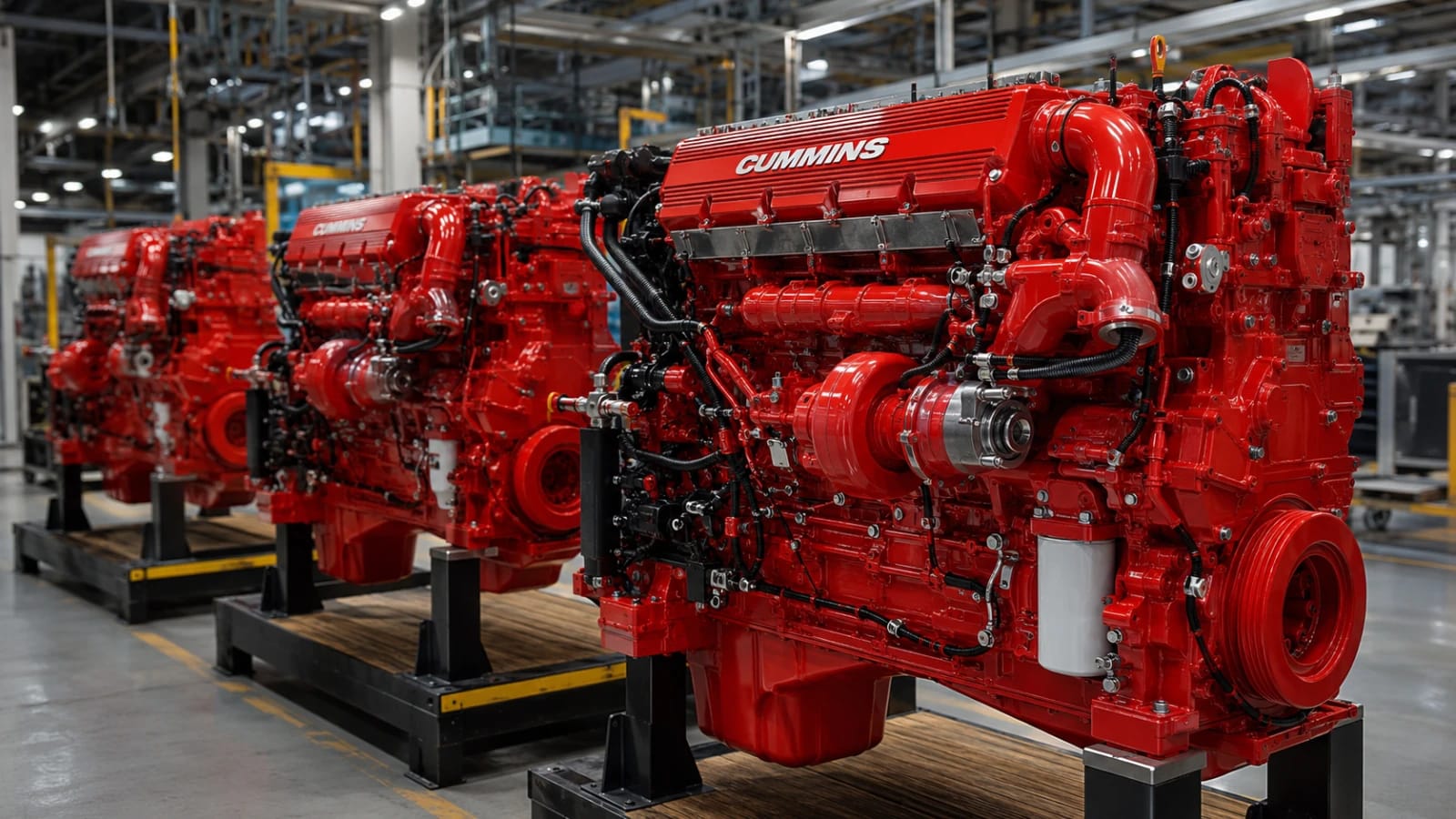
The Cummins Signature, ISX, and QSX15 engines are the backbone of heavy trucking and industrial equipment across the Americas. They share the same 15-liter mechanical architecture — the most popular in the segment — but differ in calibration, accessories, and final application. This article covers what they are, how they differ, and where you’ll find them in the field.
Everything that follows comes from the official Cummins Engine Company Troubleshooting and Repair Manual (Bulletin 3150971-00), which Cummins published as the reference for service technicians. It’s the authoritative source — not a third-party interpretation or summary.
Cummins’ 15-liter family
All three engines are born from the same base design:
- Displacement: 15 liters (912 cubic inches).
- Bore x Stroke: 137 mm × 169 mm.
- Configuration: 6 cylinders in-line.
- Firing order: 1-5-3-6-2-4.
- Crankshaft rotation (viewed from the front): clockwise.
This base design is combined with different:
- Fuel systems (pump-injector, common rail HPCR).
- Aftertreatment systems (depending on emissions standards).
- Electronic calibrations (ECM map).
- Auxiliary components (pan, flywheel, accessories).
And from there, the three main variants are born.
Signature: the flagship for heavy trucks
The Signature is the most recognized engine in the family. Designed for Class 8 heavy-duty trucks — the famous “18-wheelers” that cover thousands of miles hauling 40+ ton loads.
Key Signature features
- Power: 400-600 HP depending on calibration.
- Peak torque: typically 1,850-2,050 Nm.
- Dry weight: 1,202 kg (on-highway).
- Oil capacity: 41.6 liters (high pan) / 37.9 liters (low pan).
- Coolant: 24 liters.
- Fuel system: High Pressure Common Rail (HPCR) on the latest generations.
Typical applications
- Long-haul tractor trucks (Kenworth, Peterbilt, Freightliner).
- Premium interstate buses.
- High-tonnage agricultural tractors.
- Drayage trucks in port operations.
Across the Americas, the Signature dominates the double-trailer segment (tractor units + tandem trailers) thanks to its ability to sustain high power over thousands of continuous hours.
ISX: the on-highway standard
The ISX is Cummins’ best-selling on-highway line over the last two decades. It shares almost 100% of its mechanical parts with the Signature, but differs in:
- Calibrations to meet EPA standards across different model years (EPA 2002, 2007, 2010, 2013).
- Different aftertreatment systems depending on the standard (EGR
- DPF since 2007, plus SCR since 2010).
- A slightly wider power range in specific fleet calibrations.
Key ISX features
- Power: 385-600 HP depending on year and calibration.
- Emissions systems: vary by model year (critical for maintenance).
- Transmission compatibility: Eaton Fuller manuals, automated manuals, and Allison automatics.
The important detail
The ISX is a range of engines produced over 20+ years — Cummins has continually evolved the same model internally with different configurations. A 2005 ISX and a 2015 ISX are very different under the skin (one has EGR + DPF, the other adds SCR with DEF). When buying a used ISX, always check:
- Exact model year.
- Emissions standard it meets.
- Aftertreatment system history (older ones are simpler and cheaper to maintain).
QSX15: the industrial and generation version
The QSX15 is the industrial application of the same 15-liter engine. It’s distinguished by:
- Optimized for continuous load: while a truck’s speed and load vary constantly, a generator or industrial compressor runs at the same regime for hours or days.
- Optional larger pan: up to 94.6 liters (25 gallons) — vs 41.6 L on the on-highway version. More oil = longer intervals between changes in continuous operation.
- Internal reinforcements for sustained high-load vibration.
- Different interfaces to couple with generators, pumps, and compressors.
Typical QSX15 applications
- Stationary generators 400-600 kW (data centers, hospitals, mining).
- Large industrial compressors.
- Hydraulic fracturing pumps in oil wells.
- Large-diameter rotary drill rigs.
- Marine propulsion in mid-sized vessels.
One key fact
The QSX15 in a generation configuration can accumulate tens of thousands of continuous hours of operation with scheduled maintenance. It’s common to find units still in service with 60,000-80,000 hours — something rarely seen in on-highway applications given the type of use.
Compared technical specifications
All data comes from the official Cummins manual:
| Parameter | Signature | ISX | QSX15 |
|---|---|---|---|
| Displacement | 15 L | 15 L | 15 L |
| Bore × Stroke | 137×169 mm | 137×169 mm | 137×169 mm |
| Cylinders | 6 in-line | 6 in-line | 6 in-line |
| Firing order | 1-5-3-6-2-4 | 1-5-3-6-2-4 | 1-5-3-6-2-4 |
| Typical power | 400-600 HP | 385-600 HP | 400-600 HP |
| Dry weight | 1,202 kg | 1,202 kg | 1,370 kg |
| Wet weight | 1,266 kg | 1,266 kg | 1,474 kg |
| Pan capacity (standard) | 37.9-41.6 L | 37.9-41.6 L | 83.3-94.6 L |
| Coolant capacity | 24 L | 24 L | 24 L |
| Thermostat (range) | 82-93°C | 82-93°C | 82-93°C |
Key technical details
Valve adjustment
All three engines use the same adjustment spec (values from the manual):
- Intake valve: 0.36 mm (0.014 in) clearance.
- Exhaust valve: 0.69 mm (0.027 in) clearance.
- Injector torque: 8 N·m (70 lb-in).
- Engine brake adjustment (where applicable): 7.00 mm (0.276 in).
These are exact values a technician uses every time the engine is opened for major service. Deviating from these ranges causes combustion problems and accelerated wear.
Oil pressures
From the manual, normal operating ranges:
- Idle oil pressure (minimum at 93°C oil temperature): 69 kPa (10 psi).
- Pressure at governed speed, no load (on-highway and industrial): 241-276 kPa (35-40 psi).
- Pressure with a cold engine (startup): up to 900 kPa (130 psi) — normal due to increased viscosity.
- Pressure with a hot engine in operation: 241-276 kPa (35-40 psi) — the healthy range.
If your gauge shows values outside these, something’s going on: overly diluted oil, a clogged filter, a worn pump, or worn bearings.
Cooling system
- Capacity: 24 liters for the engine alone (the complete system with the radiator and hoses can total 40-60 L depending on the installation).
- Thermostat: opens gradually between 82°C and 93°C.
- Overtemperature alarm: 110°C (230°F) — the point where the system alerts before emergency shutdown.
- Maximum system pressure: 227 kPa (33 psi) with the thermostat closed at maximum no-load speed.
How to identify your specific engine
On the top of the rocker cover you’ll find the engine data plate. It has what you need to order parts or talk to an authorized shop:
- Engine Serial Number (ESN).
- Critical Parts List.
- Exact model.
- Rated power and RPM in the factory calibration.
There’s also an ECM (Electronic Control Module) plate on the front of the ECM containing:
- P/N (Part Number).
- S/N (Serial Number).
- D/C (Date Code).
These two numbers are the reference Cummins uses globally. Without them, it’s hard to get exact parts or technical support.
Maintenance and service life
Cummins Signature/ISX/QSX15 engines have a reputation as long-lived engines when properly maintained. Real-world references:
- Typical on-highway service life: 1,000,000 to 1,500,000 km before a major overhaul.
- Industrial service life: 15,000-25,000 hours of continuous operation.
- Stationary generation service life: 40,000-80,000 hours.
Reaching these numbers requires:
- Quality CJ-4 or CK-4 oil, changed on schedule (15,000-40,000 km on-highway, typically 500 hours industrial).
- Genuine Cummins Fleetguard filters.
- ULSD (low-sulfur) fuel.
- ELC (Extended Life) coolant to minimize internal corrosion.
- Periodic diagnostics with Cummins INSITE (the official diagnostic software).
In summary
The Cummins Signature, ISX, and QSX15 engines share the same 15-liter base architecture, adapted to three worlds: heavy trucking (Signature), mass-market on-highway (ISX), and industrial / generation (QSX15).
They share almost 100% of their internal components — a technician who knows how to service an ISX knows how to service a Signature. The differences lie in electronic calibration, auxiliary accessories, and pan/reinforcement options.
With correct maintenance, these are engines that can accumulate tens of thousands of hours or millions of kilometers of operation. They’re the reason Cummins has been a world leader in heavy diesel engines for decades.
In upcoming articles in this series we’ll open up each system: identification, diagnostics, fuel, injectors, oil, cooling, intake, exhaust, and electronic control. All based on the official Cummins service manual.
Frequently Asked Questions
What's the difference between the Cummins Signature, ISX, and QSX15 engines? +
How much power does a Cummins Signature/ISX generate? +
How much does a Cummins Signature ISX engine weigh? +
How much oil does a Cummins ISX hold? +
What machines use these engines? +
Sources
This article was drafted with AI assistance and reviewed by our editorial team before publishing.