

What Lubricating Oil Is: Fundamentals and Function
Lubricating oil prevents wear from friction in machines and engines. We explain what it is, how it's made, base oil types, and why it's critical.
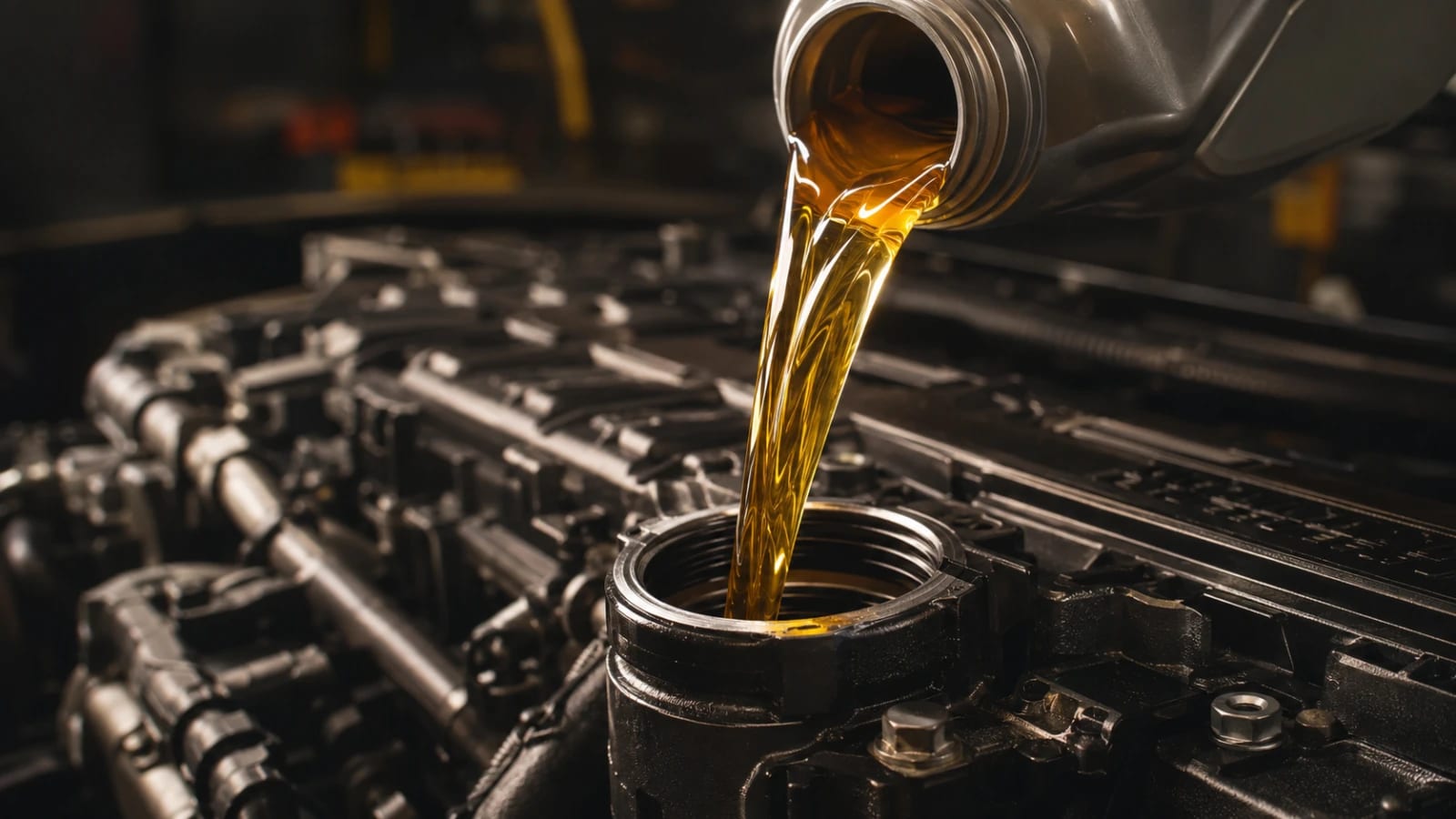
From the official manual (author Luis Vásquez): “It is the act of placing a substance between two components which, if in direct contact, would suffer wear from friction. The fight against wear has been, and will continue to be, a constant struggle for humans in preserving their machines and equipment.”
That’s the fundamental concept. Every machine — from your car to a 300-ton mining excavator — depends on lubricating oil to function. This article covers exactly what it is, how it’s made, and why quality matters so much.
Lubrication
Manual definition: the act of placing a substance between two surfaces that would otherwise be in direct contact, to prevent wear from friction.
Wear
Manual definition: “Wear on the parts of a machine in motion is the detachment of surface particles caused by friction, which results from the movement of those parts.”
Every time two metal surfaces rub against each other:
- Kinetic energy converts into heat.
- Microparticles detach from the surfaces.
- The surfaces progressively erode.
- Eventually the parts become unusable.
Everyday example: an engine bearing spins against the crankshaft at 2,000-3,000 RPM. Without oil between them, the metal glows red-hot and melts in seconds. With oil, it runs for 500,000-1,000,000 km without a problem.
What lubricating oil is
From the manual: “A lubricating oil is a liquid product that’s placed between two surfaces in motion, preventing them from wearing due to friction or rubbing.”
A modern lubricating oil serves several simultaneous functions:
- Reduces friction (primary function).
- Cools hot spots (absorbs and carries away heat).
- Seals small clearances (between piston and liner, for example).
- Cleans contaminants (holds them in suspension until the filter).
- Protects against corrosion (with anti-corrosion additives).
- Dampens internal shocks.
- Transmits force (in hydraulic systems).
A well-lubricated engine with the correct oil can last millions of kilometers. The same engine without oil will last hours.
How lubricating oil is made
From the manual: “A lubricating oil is the result of blending base oils with additive compounds; an oil is naturally lubricating, but for it to perform its function better, these additives — which give it special characteristics — need to be applied.”
The formula
A modern commercial oil contains:
- Base oil: 85-95% of the content.
- Additives: 5-15% of the content.
The base oil
From the manual: “A base oil is a fluid of mineral or synthetic origin, with lubricating properties, used to make oils and greases but without special protective characteristics.”
It’s the foundation the final oil is built on. On its own, it lubricates, but it doesn’t have the special properties (anti-wear, antioxidant, etc.) that additives provide.
The 4 types of base oils by origin
From the manual, listed by type:
1. Animal origin
The first oils used by humanity. Animal fats and oils (whale, pig, etc.). Almost never used today because of:
- Short service life (they decompose).
- Low temperature resistance.
- Ethical concerns (use of animals).
2. Vegetable origin
Oils from plants: sunflower, soy, rapeseed, canola. Used in:
- Biodegradable oils (environmentally sensitive applications).
- Eco-friendly hydraulic oils.
- Some specialized lubricants.
Advantage: biodegradable (important in protected natural areas).
Downside: shorter service life than mineral or synthetic oils.
3. Mineral origin
The most common. Comes from petroleum. From the manual: “The base oil derived from petroleum is obtained by refining petroleum, which is extracted from the subsurface and subjected to refining processes from which the base oil is obtained. Mineral oil derived from petroleum has many advantages compared to animal- or vegetable-type oils.”
Advantages:
- Low cost.
- Good service life.
- Widely available.
- Well understood technically.
Downsides:
- Limited temperature range.
- Lower efficiency than synthetics.
4. Synthetic origin
Fluids created through chemical synthesis. They don’t come directly from petroleum (though some precursors do).
Common types:
- PAO (Polyalphaolefins): the most common.
- Esters: high lubricity, very good for engines.
- Polyglycols (PAG): for specific applications.
Advantages:
- Excellent performance at extreme temperatures.
- Long service life (3-5x more than mineral).
- Better efficiency (2-4% lower fuel consumption).
- Greater chemical stability.
Downsides:
- 3-5x higher cost.
- May be incompatible with older seals.
Refining mineral oil
From the manual: “REFINING. A series of physical and chemical processes that crude petroleum is subjected to, in order to obtain base oils.”
Typical stages:
- Distillation: separation by boiling point.
- Solvent extraction: removes undesired compounds.
- Dewaxing: improves cold-temperature behavior.
- Hydrogenation: improves chemical stability.
The result: a base oil with well-defined, predictable properties.
The two types of mineral oils
From the manual, two main categories by molecular structure:
Paraffinic
“These are base oils with a high saturate content that can resist the effects of high temperatures such as oxidation, viscosity loss, volatility, and oil consumption.”
Characteristics:
- Linear molecular structure (paraffins).
- High oxidation resistance.
- Low volatility.
- Low viscosity loss.
Typical applications:
- Engine oils.
- High-temperature industrial oils.
- Standard hydraulic oils.
Naphthenic
“These are base oils that, due to their cyclic structure, exhibit high performance at low temperatures and good dielectric properties. They are mainly used in oils for transformers and refrigeration equipment.”
Characteristics:
- Cyclic molecular structure.
- Excellent cold-weather behavior.
- Good dielectric properties (don’t conduct electricity).
Typical applications:
- Electrical transformer oils.
- Refrigeration compressor oils.
- Some specialized lubricants.
Why the choice matters
At first glance all oils look the same — dark liquids sold in drums. But choosing the wrong one can:
- Destroy an engine in hours (using old-style engine oil in a modern DPF-equipped engine).
- Cut service life in half (low-grade oil in a demanding application).
- Increase fuel consumption by 3-8%.
- Cause leaks from incompatible seals (mineral-synthetic mixing in some cases).
- Void the equipment’s warranty.
The manufacturer’s specification is always the reference. Cat specifies CJ-4/CK-4, Cummins has its own standards (Cummins Valvoline Premium Blue, for example), Volvo specifies VDS-3/VDS-4.
How long oil lasts
Depends on:
- Oil type (mineral, semi-synthetic, synthetic).
- Engine use (severe vs. light).
- Environmental conditions (temperature, dust).
- Engine condition (heavy blow-by shortens life).
- Additive quality (premium additives last longer).
General references:
- Standard mineral automotive oil: 5,000-10,000 km.
- Premium mineral oil: 10,000-15,000 km.
- Semi-synthetic oil: 15,000-25,000 km.
- Premium synthetic oil: 25,000-40,000 km.
- Extended full-synthetic oil: 40,000-60,000 km.
In industrial heavy equipment, life is measured in hours (500-1,000 hours typical depending on type).
In summary
Lubricating oil is the component that makes it possible for modern machines to run without destroying themselves. It’s a blend of a base oil (85-95%) plus additives (5-15%).
Base oils come from 4 origins: animal (rarely used), vegetable (biodegradable), mineral (the most common, from petroleum), and synthetic (chemical synthesis, premium).
Within mineral oils, there are two types by molecular structure: paraffinic (high temperature, good for engines) and naphthenic (low temperature, good for transformers and refrigeration).
Choosing the correct oil per the manufacturer’s specification is the most cost-effective maintenance investment there is. The wrong oil can destroy a USD 30,000 engine in a short time.
In upcoming articles in this series, we’ll cover each aspect in depth: mineral vs. synthetic, additives, API/SAE/ISO classifications, SOS analysis, change intervals, and contamination.
Frequently Asked Questions
What is the main function of lubricating oil? +
How is lubricating oil made? +
What is a base oil? +
What's the difference between paraffinic and naphthenic oils? +
What happens if I don't lubricate an engine? +
Sources
This article was drafted with AI assistance and reviewed by our editorial team before publishing.