

What Is a DPF (Diesel Particulate Filter): Function and Types
The DPF is the filter that traps particulate from diesel exhaust. We explain what it is, how it works, types, materials, and why it's mandatory.
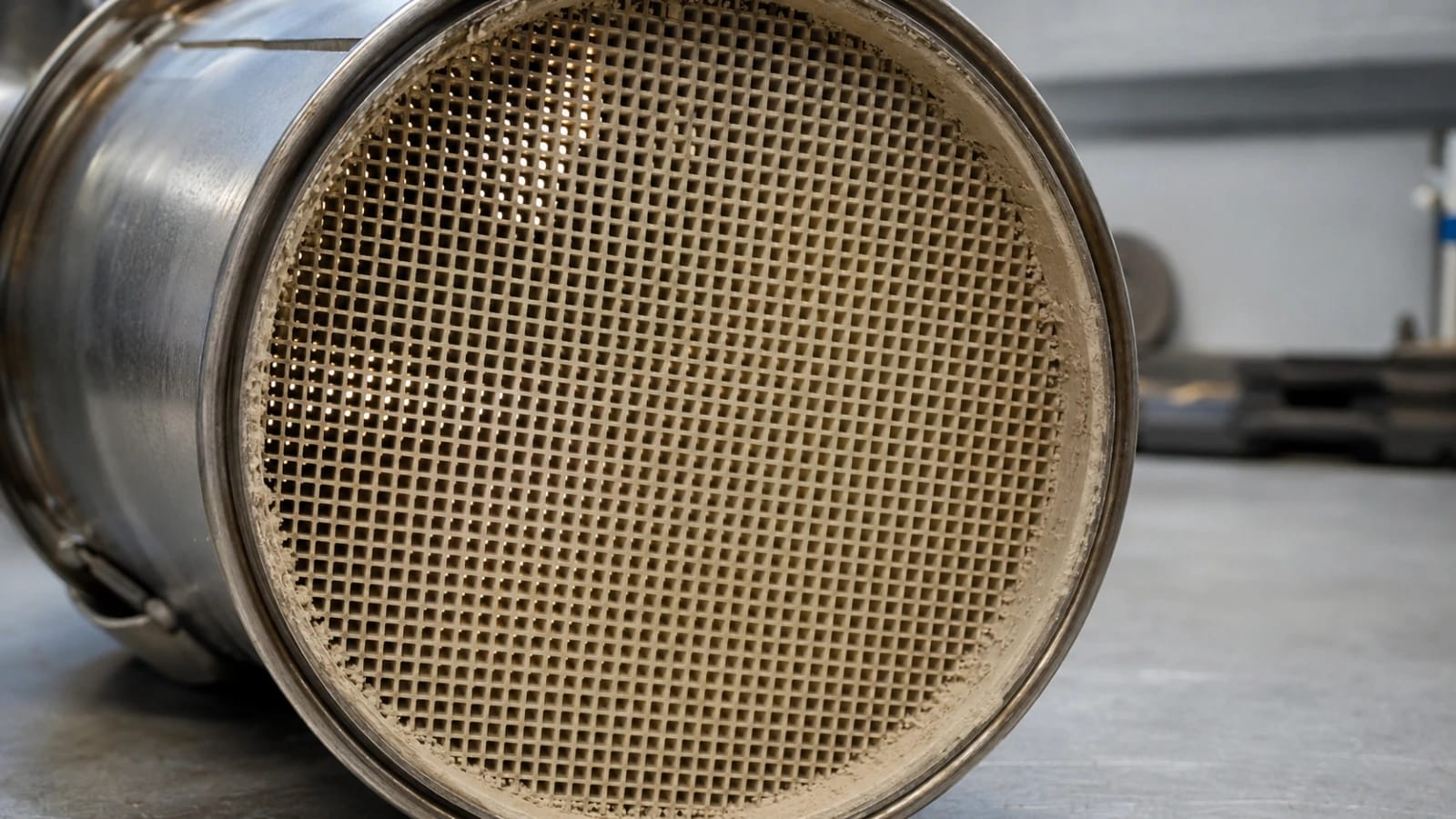
When a diesel engine starts, fuel mixes with air inside the cylinder and burns in a controlled explosion. That process, no matter how efficient, always generates soot — small carbon particles that didn’t fully burn. With nothing to contain it, that soot goes out the exhaust, shows up as black smoke, and pollutes the air.
The DPF (Diesel Particulate Filter) is the solution the industry adopted to capture that soot before it reaches the atmosphere. Since 2007 it’s been a mandatory component on on-highway diesel engines in the US, and since 2011-2015 in heavy equipment as well under the Tier 4 Interim/Final standard. Any technician working on modern engines — Cat, Cummins, Volvo, Detroit, Komatsu, John Deere — needs to understand what it is, how it works, and when each type applies.
What a DPF actually does
In one sentence: it physically traps soot.
Internally, a DPF is a metal cylinder containing a ceramic matrix with thousands of parallel channels. The channels are alternately plugged: one is capped on the inlet side, the next one on the outlet side, the next one on the inlet side again, and so on.
When exhaust gas comes in, it can’t flow straight through — it’s forced through the porous walls between channels to reach the adjacent channel and exit. Those walls act as a filter: they let gases through (CO₂, H₂O, N₂, some residual NOx) but retain the solid soot particles.
The result: more than 90% of the particulate matter gets trapped inside the filter. Clean gases exit through the final exhaust.
Two mounting types by capacity: single and dual
Manufacturers offer two configurations depending on engine size:
Single DPF (individual)
One filtering canister, used on engines up to ~600 HP. It’s the most common configuration:
- 20-30 ton excavators (Cat 320, 330, 336).
- Medium wheel loaders (Cat 950, 962, 966).
- On-highway tractor trucks.
- Intercity buses.
- 200-500 kVA stationary generators.
A single DPF measures between 30 and 60 cm in length by 25-40 cm in diameter, depending on engine size. It weighs between 25 and 55 kg.
Dual DPF (double)
Two twin canisters mounted in parallel, used on engines of 600 HP and up. More filtering surface is needed to handle the higher volume of exhaust gas:
- Mining trucks (Cat 777, 785, 793).
- Very large excavators (Cat 390F, 395, 6015B).
- Giant wheel loaders (Cat 988K, 990K, 993K).
- Large motor graders (Cat 24M).
- 800+ kVA stationary generators.
The two DPFs connect to a common manifold, split the exhaust flow in two, each filters its share, and the clean gases rejoin in another manifold before exiting. Temperature and pressure sensors are duplicated — Particulate Trap #1 and Particulate Trap #2.
Two mounting types by orientation: horizontal and vertical
The same DPF unit can be mounted horizontally or vertically depending on the equipment:
Horizontal mounting
Typical on:
- Tractor trucks: under the chassis, between the wheels.
- Intercity buses: under the body.
- Articulated construction trucks: between the chassis and the dump box.
Advantages: lower overall height, lower center of gravity, easier maintenance access from below with a service pit.
Vertical mounting
Typical on:
- Excavators: next to the engine, taking up the vertical space in the counterweight area.
- Wheel loaders: vertically alongside the engine.
- Motor graders: vertical between the engine and the rear hood.
- Stationary generators: vertically over the engine’s exhaust.
Advantages: smaller horizontal footprint, more compact side-to-side, better for equipment with limited side clearance.
Orientation doesn’t affect filtering efficiency, but it does require sensors to be positioned at the correct points per the manufacturer’s diagram.
What a DPF is NOT: common confusions
It’s important to tell the DPF apart from other exhaust system components it’s sometimes confused with:
- DOC (Diesel Oxidation Catalyst): goes before or after the DPF. It oxidizes unburned hydrocarbons (HC) and carbon monoxide (CO) — it does not filter particulate matter.
- SCR (Selective Catalytic Reduction): a catalyst using urea/DEF. It reduces NOx — it also does not filter particulate matter.
- Muffler: reduces exhaust noise — it doesn’t treat emissions at all.
On a modern Tier 4 Final or Euro VI engine, all of these components coexist in sequence. A typical system: engine → turbo → DOC → DPF → SCR → muffler → outlet. Each with a specific function.
Why you can’t just remove the DPF
Many operators and shops — especially outside the countries with the strictest enforcement — have been tempted to remove the DPF (“DPF delete”) thinking the engine will perform better. It’s a technical mistake and a legal risk:
Technically:
- The ECU is calibrated to operate WITH a DPF installed. Removing it causes the differential pressure and temperature sensors to report out-of-range values, and the ECU throws fault codes (
Diagnostic Flash CodesDFC 100, 101, 102 on Cat). - The ECU can go into derate mode (reduced power) or even a protective shutdown if it detects the DPF’s absence for too long.
- Without a DPF, the engine produces extreme opacity — black smoke visible from hundreds of meters away. It fails any emissions inspection.
Legally:
- In the US, removing the DPF violates the Clean Air Act. Federal fine: up to USD 4,735 per unit per day. Hundreds of existing court cases.
- In many countries, vehicle emissions inspections measure opacity and reject equipment that doesn’t comply, with additional civil environmental liability in some jurisdictions.
- On job sites in urban areas, local environmental authorities can penalize operating equipment with uncontrolled emissions.
The only correct way to “extend the life” of a DPF is preventive maintenance: periodic ash cleaning, sensor checks, using low-sulfur ULSD diesel, and CJ-4 or CK-4 engine oil (low sulfated ash content).
How long a DPF lasts
Under normal operating conditions:
- Regeneration: every 8-24 hours of operation (the ECU decides based on differential pressure and temperature).
- Ash cleaning: every 4,500-6,000 hours of operation. The DPF is removed and sent to a specialized service that uses reverse compressed air and sometimes an oven to burn off residue.
- Substrate replacement: every 15,000-20,000 hours, or when cleaning no longer brings differential pressure back to the normal range. Typical cost: USD 3,000-6,000 for trucks, USD 6,000-12,000 for large heavy equipment.
A poorly maintained DPF can clog in 3,000-5,000 hours. A well maintained one comfortably reaches 20,000 hours before replacement. The difference is maintenance.
In summary
The DPF is the component that makes a modern diesel engine legal to operate across most of the developed world. It physically filters soot before it reaches the atmosphere, with an efficiency above 90%.
It comes in single (engines up to 600 HP) and dual (larger engines) versions, and mounts horizontally or vertically depending on the equipment’s design. It’s a relatively robust component but sensitive to maintenance: using poor-quality diesel, the wrong oil, or skipping ash cleaning can kill it prematurely.
In upcoming articles we’ll open up the DPF internally, look at how regeneration works, and how diagnosis is done when something fails.
Frequently Asked Questions
What exactly is a DPF? +
Do all modern diesel engines have a DPF? +
What's the difference between a single and dual DPF? +
Can a DPF be mounted horizontally or vertically? +
Can the DPF be removed to 'free up' the engine? +
Sources
This article was drafted with AI assistance and reviewed by our editorial team before publishing.