

What Is Caterpillar's ACERT System and How Does It Work
ACERT combines 5 technologies (series turbochargers, CGI, DPF, high-pressure injection, and valve actuation) to meet EPA 2007 without sacrificing power.
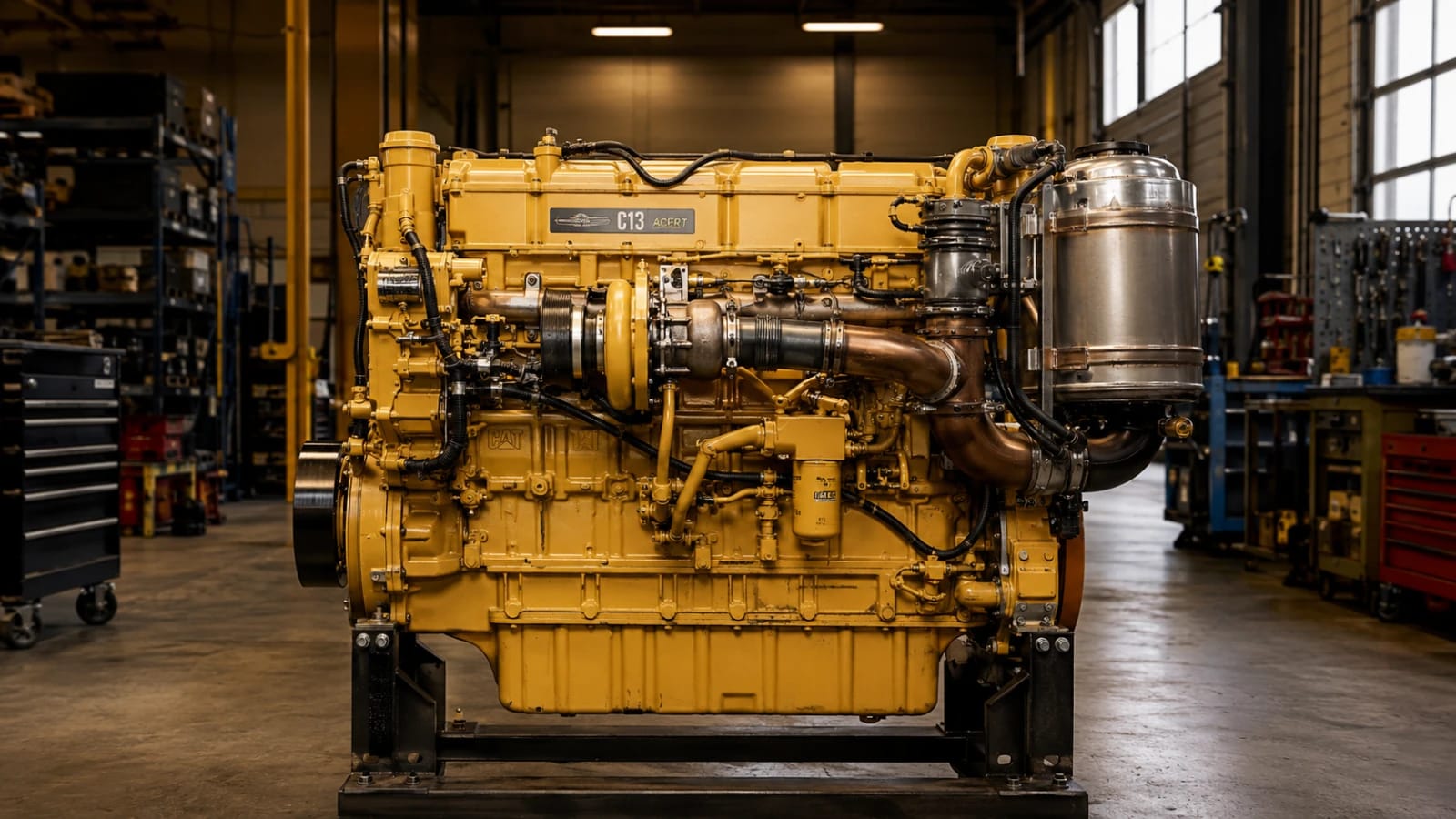
In 2007, the US EPA imposed the strictest emissions limits the diesel engine industry had ever faced. Every manufacturer had to redesign how their engines burned fuel and what gases they let out into the air. Caterpillar answered with its own architecture: ACERT.
ACERT isn’t a bolt-on part. It’s a coordinated set of five technologies working together to cut pollutants without punishing power output. It’s the reason a 2010 Cat C15 can produce almost the same output as a 1998 model while meeting standards five times stricter.
What does ACERT mean?
ACERT stands for Advanced Combustion Emissions Reduction Technology. The key word is “combustion” — Caterpillar’s philosophy was to attack the problem inside the cylinder, not just treat the gases after they leave.
Other manufacturers, especially European ones like Volvo or MAN, bet on SCR (Selective Catalytic Reduction): they let the engine burn fuel the usual way and treat the exhaust gases with urea downstream. Cat chose the opposite path: modify combustion itself to produce fewer pollutants from the start, then use a filter (DPF) to catch what’s left.
Why ACERT was created
Between 2004 and 2010, EPA standards (and their European equivalents, Euro V and VI) cut allowable diesel emissions limits by more than 90%. Four pollutants were the focus:
- Particulate matter (PM): the black soot you see coming out of the exhaust
- Nitrogen oxides (NOx): invisible gases that cause acid rain and smog
- Hydrocarbons (HC): unburned fuel
- Carbon monoxide (CO): a toxic gas from incomplete combustion
With traditional 1990s-era engines, it was impossible to meet those limits without sacrificing power or fuel economy. A completely new architecture was needed.
The 5 components of the ACERT system
1. Series turbochargers
Instead of one large turbo, ACERT uses two turbos connected in sequence: a high-pressure unit (small, fast-spooling, kicks in at low RPM) and a low-pressure unit (large, delivers volume at high RPM). This gives fast response at idle and strong power at full load, with much less turbo lag.
The result: more air per cycle, which lets the engine burn more fuel completely, cutting soot (PM) and carbon monoxide (CO).
2. CGI — Cooled Gas Induction
CGI is Cat’s version of EGR (Exhaust Gas Recirculation). It takes a portion of the exhaust gas, cools it in a dedicated heat exchanger, and reintroduces it into the intake.
Why? Cooled exhaust gas lowers peak combustion temperature. Since NOx forms mainly when the nitrogen in the air reaches temperatures above 1,500°C (2,732°F), cooling combustion lets the engine produce up to 40% less NOx than an engine without CGI.
3. DPF — Diesel Particulate Filter
This is the most visible ACERT component. A large metal canister mounted in the exhaust that traps soot (unburned carbon particles) in an internal ceramic matrix made of cordierite or silicon carbide.
Every so many hours, the system runs a regeneration: it burns off the accumulated soot at high temperature, leaving only minimal ash. Without a DPF, there would be no way to meet the EPA 2007 PM limit (10 times stricter than EPA 2004).
We’ve published a full DPF guide covering its structure, sensors, and maintenance.
4. High-pressure injection system
ACERT injectors operate at 1,800 bar (26,000 psi) or more (versus 800-1,200 bar on pre-2007 engines). This atomizes the diesel into much finer droplets, which mix better with air and burn more completely.
The ECU also controls multi-pulse timing per cycle: a small “pilot” injection before the piston rises, the main injection, and one or two “post-injections” that assist DPF regeneration. All of it happens in milliseconds.
5. Variable intake valve actuation
A mechanism inside the engine’s cylinder head allows changing when the intake valves open and close. This adjusts the amount of air and the “overlap” with the exhaust valves depending on RPM.
At idle it reduces airflow (less soot); under high demand it maximizes it (more power). It’s an industrial version of what sports cars call “VVT” or “VVT-i.”
How ACERT compares to SCR
The comparison between these two approaches sparked a huge technical debate in the industry between 2007 and 2015:
| Aspect | ACERT (Cat) | SCR (Volvo, MAN) |
|---|---|---|
| Approach | Reduces in-cylinder | Treats in exhaust |
| Requires urea/DEF | ❌ No | ✅ Yes |
| Needs a DPF | ✅ Yes (large) | Optional |
| Maintenance cost | Medium | Low, but + urea |
| Electronic complexity | High | Medium |
| Space required | Compact | Takes up more volume |
Today, most modern manufacturers combine both approaches: EGR/CGI + DPF + SCR. It’s no longer “one or the other.” Post-2011 Cat engines (Tier 4 Final) also incorporate SCR with urea, complementing the original ACERT design.
Operational impact of ACERT
For anyone operating a machine with ACERT, some practical things change compared to pre-2007 engines:
- Fuel consumption: essentially the same, with a slight increase from DPF regeneration (~1-3%).
- Diagnostic complexity: much higher. There are dozens of sensors (temperature, DPF differential pressure, CGI flow, air quality) and it’s not practical to diagnose without a service computer (Cat ET).
- Maintenance: new items such as DPF ash cleaning (every 4,500-6,000 hours) and CGI system checks that didn’t exist before.
- Cleaner diesel required: ACERT engines need ULSD (Ultra Low Sulfur Diesel, <15 ppm sulfur). Diesel with higher sulfur content destroys the DPF’s platinum catalyst.
In summary
ACERT was Caterpillar’s answer to a complex regulatory problem: meeting emissions limits ten times stricter without losing the power and reliability that define the brand. The solution was integrating five technologies — series turbochargers, CGI, DPF, high-pressure injection, and variable valve actuation — into a system coordinated by the engine’s ECU.
For today’s operator or technician, understanding ACERT isn’t optional: it’s the foundation of how Cat engines have worked since 2007. Any diagnostic work, predictive maintenance, or troubleshooting comes back to knowing these five pieces and how they interact. In upcoming articles, we’ll open up each component individually.
Frequently Asked Questions
What does ACERT stand for in Caterpillar engines? +
What components make up the ACERT system? +
Is ACERT better than SCR (Selective Catalytic Reduction)? +
Which Cat engines use ACERT? +
How does ACERT affect fuel consumption? +
Sources
This article was drafted with AI assistance and reviewed by our editorial team before publishing.