

Cummins ISX Fuel System: HPCR Common Rail Explained
The Cummins ISX/Signature fuel system uses high-pressure pumps and HPCR common rail. We cover the pump, filters, lines, and pressure regulation.
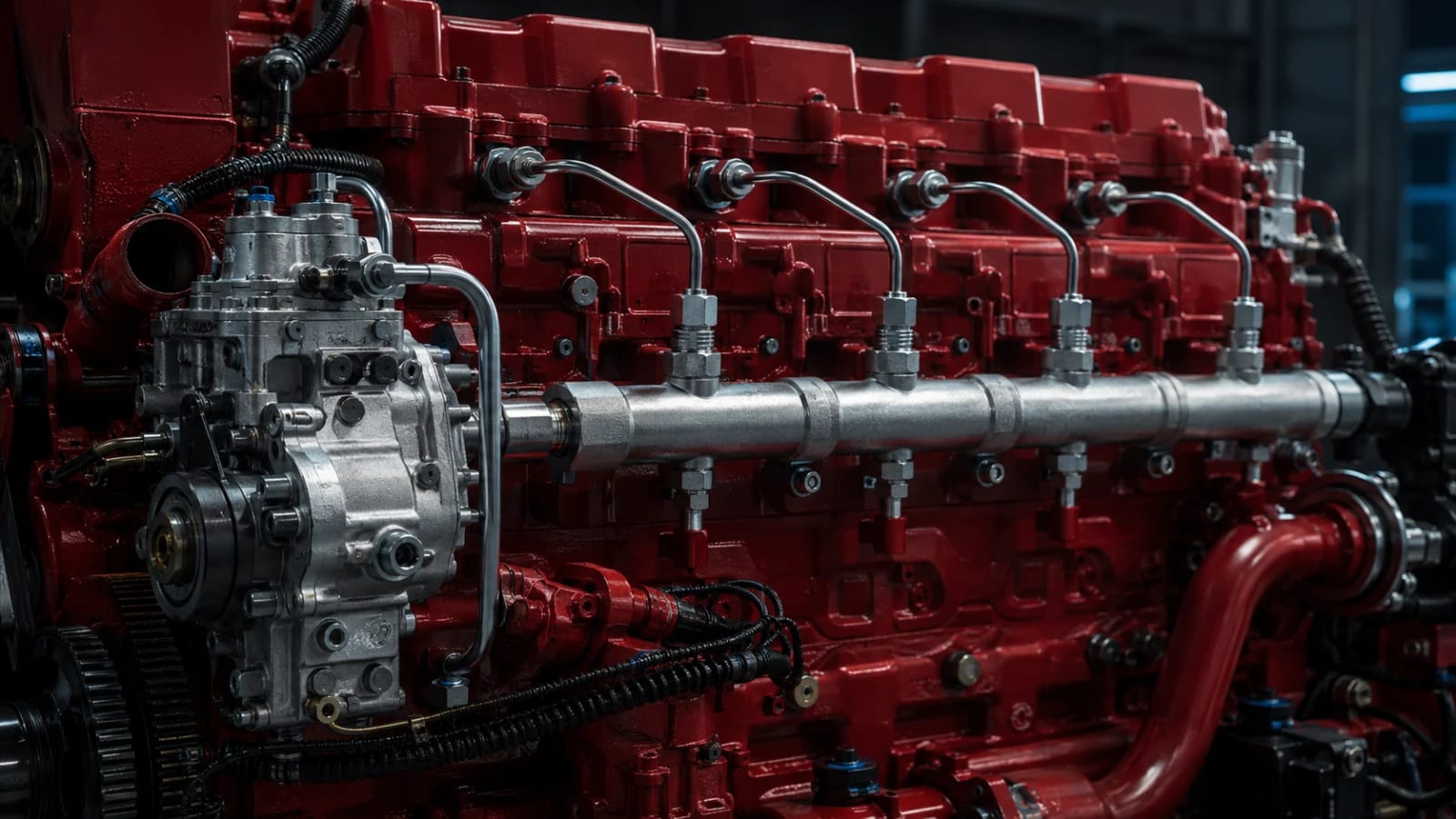
The fuel system is arguably the most critical subsystem of the modern Cummins ISX/Signature. Its high-pressure common rail (HPCR) technology is what let Cummins meet post-2007 EPA standards while also improving engine performance and fuel economy.
This article covers the complete system: the high-pressure pump, common rail, electronic regulation, filters, and lines. Everything is based on Section 5 - Fuel System of the official manual.
Overall system architecture
The fuel system on a modern ISX/Signature has two zones:
1. Low-pressure zone:
- Fuel tank.
- Transfer pump (lift pump).
- Filters (primary + secondary).
- Low-pressure lines to the engine.
2. High-pressure zone:
- High-pressure pump (HPCR pump).
- Common rail.
- Pressure Control Valve (PCV).
- Rail pressure sensor.
- High-pressure lines to the injectors.
- 6 electronic injectors.
Fuel flow path
- The transfer pump draws diesel from the tank.
- Fuel passes through the pre-filter (water separator) and fine filter.
- It arrives at the engine at low pressure (~5-10 bar).
- The high-pressure (HPCR) pump raises it to 1,600-2,200 bar.
- Pressurized fuel accumulates in the common rail.
- The ECM commands each injector, which meters fuel into the cylinder based on the calculated timing and quantity.
- Unused fuel (leak-off) returns to the tank through the return line.
The transfer pump (lift pump)
Also called the feed pump or primary pump.
Function: draw diesel from the tank and deliver it at low pressure to the engine’s fuel system.
Typical specifications:
- Type: gear or roller vane.
- Output pressure: 5-15 bar (depending on year/version).
- Location: mounted on the engine, near the secondary filter.
- Drive: mechanical (gear-driven off the crankshaft) or electric, depending on generation.
Typical failure
A worn transfer pump doesn’t deliver enough pressure to the high-pressure system. Symptoms:
- Hard cold starting.
- Power loss under load.
- Low fuel pressure fault codes.
Diagnosis: measure pressure with an external gauge on the supply line. If it’s below 5 bar, the pump has failed.
Replacement cost: USD 500-1,200 in parts.
Fuel filters
The ISX has TWO filters in series:
Primary filter (Pre-filter / Water Separator)
- Location: near the fuel tank.
- Function: separate water from the fuel + retain coarse particles.
- Mesh rating: ~30 microns.
- Replacement interval: every 25,000-50,000 km.
This filter is critical because diesel sometimes contains water (from tank condensation or contamination during distribution). Ignoring it lets water reach the secondary filter and clog it quickly.
Secondary filter (Fine filter)
- Location: on the engine.
- Function: retain fine particles (last line of defense before the HPCR pump).
- Mesh rating: 4-10 microns.
- Replacement interval: every 15,000-30,000 km on-highway, 500 hours industrial.
This filter cannot be skipped. The HPCR pump and injectors have internal clearances of 1-3 microns. A 10-micron particle will scratch and destroy the system.
Changing filters: the correct procedure
- With the engine cold, drain water from the primary filter if it has a petcock.
- Remove the secondary filter with a strap wrench.
- Fill the new filter with clean diesel before installing it (this avoids cavitation at startup).
- Install it hand-tight — do NOT use force with wrenches.
- Purge the system with the manual priming pump (if equipped) or with the starter.
The HPCR high-pressure pump
The most expensive and critical component in the system.
Function: raise fuel from ~5-15 bar to 1,600-2,200 bar.
Typical specifications:
- Type: radial pistons (most common) or axial.
- Output pressure: 1,600-2,200 bar in normal operation.
- Maximum pressure: up to 2,400 bar in peaks.
- Drive: mechanical, via camshaft gears.
- Regulation: through a PCV commanded by the ECM.
The HPCR pump works under extreme conditions
- Pressures 8-10 times higher than older systems.
- Operating speed: up to 3,000 RPM.
- Fuel as the only lubricant: if the diesel is contaminated, the pump gets destroyed.
Typical replacement cost: USD 3,000-5,000 in parts plus labor. A complete set can reach USD 8,000.
Typical failures
- Contamination: fuel particles scratch internal surfaces.
- Water in the diesel: causes cavitation and corrosion.
- Oil contaminating the diesel (rare, but seen in cross-failures).
- Simple wear from hours of operation — typical service life 500,000-1,000,000 km.
Common rail
Function: store pressurized fuel ready for injection.
It’s a rigid, high-strength steel tube with 6 outlets — one for each injector.
Specifications:
- Material: forged steel, treated for high pressure.
- Internal volume: variable, typically ~20 cc.
- Working pressure: 1,600-2,200 bar.
- Integrated pressure sensor: reports to the ECM.
Function of the rail
Without the rail, pressure would fluctuate every time an injector opens. The rail acts as an accumulator that dampens these oscillations, keeping pressure stable for all 6 injectors.
The injectors draw from that pressurized oil reservoir according to the timing and quantity commanded by the ECM.
Pressure Control Valve (PCV)
Function: keep rail pressure at the target value set by the ECM.
How it works:
- The ECM sets a target pressure (varies with load, RPM, temperature).
- The rail sensor reports actual pressure.
- If actual > target: the PCV opens and dumps fuel to the return.
- If actual < target: the PCV closes further, and pressure rises.
This control happens in milliseconds — it’s what allows the precise emissions and fuel-consumption control of a modern ISX.
Typical failures
- PCV stuck open: constant low pressure, engine without power.
- PCV stuck closed: pressure too high, triggers the relief valve, fault codes.
- Worn PCV: unstable pressure, engine “rattles” and consumption rises.
Replacement: USD 200-500. Relatively cheap service but requires purging the system.
High-pressure lines
The tubes running from the rail to each injector are built from high-strength steel with very tight tolerances.
Specifications:
- Internal diameter: 3-4 mm.
- Outer diameter: 8-10 mm (thick walls).
- Length: identical to each other (so every cylinder gets the same timing).
- Ends: precision conical fittings with a specific torque spec.
Special precautions
- NEVER reuse bent or damaged lines: they can rupture.
- Exact torque on reinstall (typically 25-30 N·m).
- Replace all 6 lines together when replacing injectors.
- Do not compress or strike the lines during removal.
A high-pressure line with a microscopic crack can fail catastrophically — a fuel jet at 2,000 bar can cut through human skin.
The fuel used
Manual requirements for diesel in a modern ISX:
- Standard: ULSD (Ultra Low Sulfur Diesel).
- Maximum sulfur: 15 ppm (0.0015%).
- Water content: less than 0.05%.
- Particle contamination: filtered below 4 microns.
- Density: 820-860 kg/m³ at 15°C.
- Cloud point: matched to climate.
Additives
Cummins does NOT recommend “miracle” aftermarket additives. Modern ULSD already comes with:
- Antioxidants: prevent degradation during storage.
- Anti-foaming agents: to avoid bubble formation while pumping.
- Lubricity additives: important because ULSD has less natural lubricity than older diesel.
Only in very cold climates is it worth adding a specific anti-gelling agent.
System failure diagnosis
With Cummins INSITE you can read in real time:
- Rail pressure (actual vs. target).
- PCV command (% opening).
- Estimated consumption.
- Injector balance (how much each one trims).
Typical tests:
- Rail pressure under load: should reach nominal values when power is demanded.
- Ripple test: pressure shouldn’t oscillate more than ±50 bar in stable operation.
- Injector balance test: all 6 should trim within ±5% of each other.
Any large deviation points to: a worn HPCR pump, a faulty PCV, a failing injector, or a bad pressure sensor.
In summary
The HPCR common rail fuel system on the Cummins ISX is what let the engine meet modern EPA standards while keeping its efficiency and power. It operates at extreme pressures (1,600-2,200 bar) with microscopic tolerances.
The critical components are the HPCR pump (USD 3,000-8,000 to replace), the filters (which must be changed on schedule), and the high-pressure lines (which don’t allow reuse of damaged parts).
Enemy #1 is fuel contamination — particles, water, or high-sulfur diesel. Disciplined attention to filters and fuel quality is the only way for the system to reach its expected 500,000-1,000,000 km service life.
Frequently Asked Questions
What is HPCR on a Cummins engine? +
What pressure does the ISX common rail operate at? +
How often should the fuel filters be changed? +
Can I use any diesel in a modern Cummins ISX? +
How does common rail pressure regulation work? +
Sources
This article was drafted with AI assistance and reviewed by our editorial team before publishing.